
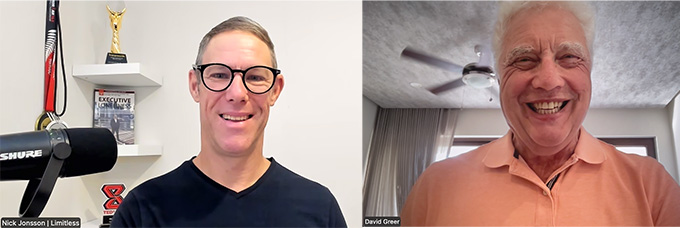
Nick Jonsson created The Limitless Podcast to inspire all of us to explore and reach beyond our personal limits. Join Nick and I as we discuss:
- My biggest secret—that I was an alcoholic.
- How I admitted I had a “drinking problem” for the very first time to an amazing coach, Kevin Lawrence.
- Despite drinking many drinks every single day, getting help was not a sign of weakness—it was the most important decision I ever made.
- You can recover. My path is through 12-step recovery.
- “Dry” and “sober” are not the same thing.
- I broke my anonymity deliberately to reduce stigma of alcoholism.
- You do not have to do this alone—and the truth is, you cannot.
Audio
Transcript
David Greer (00:00):
I’ve been a daily drinker for over 20 years, and the progressive nature—my experience of alcoholism is it’s a progressive disease and I drank more and more and more over time and I was drinking 12, 15, 18 drinks a day. That’s most of it. At home I had to get help. In my case, it was Coach Kevin and Coach Kevin got me to 12 step recovery and 12 step recovery got me this entire group of people, which have helped me to show a way of life that is free of alcohol and gives me many, many tools to deal with life.
Nick Jonsson (00:34):
Welcome back to another episode of Limitless Podcasts. Today we have with us David Greer and he is a sober coach and a coach, and he is himself 16 years sober. A warm welcome to you, David. How are you?
David Greer (00:52):
I’m doing really well Nick, and thank you for having me on the podcast.
Nick Jonsson (00:57):
It is our pleasure. Indeed. I think the topic is so important to cover, especially now perhaps in the beginning of the year. I know many start of the year saying I’m going to have a dry January, and I’m sure we’re going to talk about the term dry and sobriety today. And I know there’s also many who’s not even managed to keep the dry January. Maybe they’re not on the right path. So we will explore all of these things today. But before we do that, David, maybe you can share a little bit of your story and why did you choose to become a coach supporting entrepreneurs and also in sobriety?
David Greer (01:34):
Well, I decided to become a coach for a couple of reasons. One is in my mid fifties I did an executive gig for three years and I came out of that and realized I’d worked as hard as I had ever worked in my career and I decided I didn’t need to prove to anyone that I could work hard. And so I wanted to do something where I didn’t have to work quite so hard. Now, in the subsequent 10 years, it turns out that not working hard is actually one of the really hardest things in my life. I’m very hardwired that way, so that’s been part of my personal growth. An extraordinary coach, Kevin Lawrence, who I think you might’ve had on the podcast, I hired Kevin on my 50th birthday because he made me in five minutes more uncomfortable than I’d been in a number of years, and made me understand for myself how unfulfilled I was and what I was doing at the time, which was angel investing, working in startups and being on board of directors. And it was very unfulfilling and we worked together for 18 months. We worked together for nine years, but after 18 months, I believe the universe put Kevin in my path for the purpose of getting me sober. And on January 27th, 2009, I admitted to Kevin my deepest, darkest secret that I’d never told anyone else, which is on a coaching call that afternoon, Kevin. I have a drinking problem, which I did. I’d been a daily drinker for over 20 years, and the progressive—my experience of alcoholism is it’s a progressive disease and I drank more and more and more over time and was drinking would be, I wouldn’t start till five, then four, then three thirty. And Kevin in his private life had a summer place where he had encountered someone with 20 years in the most well-known 12 step recovery program. And Kevin doesn’t have a drinking problem, but he is a curious, really infinitely curious guy. And so he asked a lot of questions and learned from this individual about the 12 step program of recovery. And so when I showed up, Kevin knew what to do, which is he made me have a commitment to go to a 12 step meeting by that Friday. That meeting happened to be on a Tuesday or our coaching call was a Tuesday. And being the overachiever that I am, I looked up meetings later that afternoon and I had a networking event downtown that finished at eight and lo and behold, there would be a 12 step recovery meeting, a quarter of a block off the road I would be driving down to go home, that started at eight thirty.
David Greer (04:35):
And I went to that meeting, I was scared. Spitless probably took me five years before I ever admitted that to anyone. I got welcome, my two lovely young ladies who I was hiding out in kind of the back and they came and found me and welcomed me. And in the course of that meeting towards the end they said, is there anyone new to the program that would like to stand and introduce themselves? And I did. I sat on my hands for about 20 seconds, but eventually I stood up and said, I’m David, I’m an alcoholic. And that meeting is the Kitsilano group meeting every Tuesday night at eight thirty and a month or so later, I made up my home group, which is a group you commit to going to every week, which I do when I’m in town. And not last Tuesday because I flew to Port Val to Mexico from my home in Vancouver last Tuesday, but the Tuesday before I was at my home group and there were a couple individuals who were there that night who were there the night that I walked in almost 17 years ago. And that continuity, that being witness, that being seen for who I am has very much been an important and really important part of my recovery from alcoholism.
Nick Jonsson (05:55):
Thank you so much for sharing that, David. And I want to take you back to that moment when you were talking to Kevin and you decided to open up to him. That is something that I think many of the listeners are looking for, that kind of safe space, that kind of trust where we just feel so safe that we actually say perhaps the things that we haven’t told anyone before. You said that you had worked with Kevin for about a year or two years, and then maybe you can just elaborate a little bit. What was it that built it up that you felt safe enough to share that with Kevin in that moment?
David Greer (06:31):
Kevin and I embarked on his standard process, which, and Kevin is my kind of guy, he’s all in or all out. So the first coaching session I had with Kevin was two eight-hour days. So that’s kind of the intensity that he brought into new clients. And over 18 months, we basically cleared all the clutter off the table, the career stuff, we got my career reestablished, we’d cleared up some personal messes and just really cleaned up a whole bunch of stuff till the only thing that was left was the elephant in the room. Now here’s kind of the dichotomy of my experience. I was as afraid as I was. Well, here’s the deal. I knew by that point with Kevin that once I admitted my truth to him, he’d never let me off the hook. I didn’t know what that looked like. I didn’t know what that meant. I didn’t know how I was going to eat a meal without wine, but I knew it was a one-way street, a one-way door. Once I opened that door, I knew Kevin was never going to let me completely close it. And so I was very afraid of what that would look like, but at the other hand, I was so sick and tired of being sick and tired. I just to be beholden to the alcohol to be chasing every week I was drinking 12, 15, 18 drinks a day and most of it at home. That’s a lot of booze to get in the house. That’s a lot of empties to get out of the house, a lot of your time and energy is just going into feeding this habit. And I just literally got so sick and tired that I was willing to crack the door open. And I think it was just that months and months of working together and cleaning all the other stuff up together and Kevin proving why he should be trusted because he just helped me get what I wanted in life and in business.
Nick Jonsson (08:44):
I love the fact that Kevin had worked with you on your whole life, built up the trust, you felt safe, you have looked at all the other areas as you said and left was only that elephant in room. And I like to do that as well in the work with my client by looking at the wheel of life, all the areas of their life and pinpointing every area. And we can use that as a stepping stone where we are actually having some wind, we’re building up that trust, we’re working on things. And when we then are removing the alcohol, that means that we also actually have built up the life. Because just as I shared in the opening here today, the issue is if all we do is remove the alcohol, well then we are dry. We are perhaps not ready for it and maybe it’s not sustainable. David, so maybe you can elaborate a little bit and give some insights also how it worked for you when you did remove it. You mentioned your first meeting and so on, but how was it for you that first, should we say the first year?
David Greer (09:41):
The first year went relatively well in the big scheme of things, except perhaps with my spouse who still to this day doesn’t believe I’m an alcoholic because I’m not a trucker or a logger. I don’t go to bars and get in fights on Friday night and I don’t live on the wrong side of the tracks and live under a bench and drink out of a brown paper bag. But the main thing, what I was taught early in the program of recovery is to get right in the middle of the tribe and bring the cloak of recovery around me. And I did hear that and I did do that. And so from very early on I was going to probably three meetings a week at least a couple hours from now, I’m going to get together with my group of men who for 17 years now, very early in my sobriety I found a private men’s step group. And that has been a fundamental part of my sobriety. I was listening to one of your other podcasts with a gentleman who’d really suffered from anxiety and eventually from depression and he was starting a men’s group in Sydney. And I think this is one of the things we get in recovery as we have these opportunity to have private men’s group where we can get together. And it’s another example of trust. Like I went for the first year and probably didn’t share that deeply, but I listened as person after person after person shared their experience, strength and hope and recovery. And we’d read from one of these books in our literature and they would share what it meant to them, which would, if there were 17 people in the room, I probably got 17 different versions. And that really helped me understand I get to make this what I want to make it to be. And I also got to learn that it’s not about taking the alcohol away, it’s about how do I live life’s on life’s terms without my number one solution when things are not going well, I can’t go back to picking up a drink, but life still happens. There’s still bumps in the road, things go sideways. And to have this intimate group of men who have been such a fundamental part of my life share, we talk about it oftentimes every week. We just thank each other for the ability to be able to share deeply and truthfully and emotionally because there’s not much in western society that demonstrates that that’s not an acceptable manly behavior. In large part, I don’t believe. And yet it has been so, so important to my personal growth and my recovery.
Nick Jonsson (12:29):
And I like the fact that you touched on also that perhaps your wife were not ready to see you as an alcoholic. That’s something that I hear from quite a few men I’m working with right now actually, where perhaps their parents are not ready or the sister is not ready to admit that. Actually no, my brother is not an alcoholic. He’s this high performing founder who’s doing so well. He’s perhaps the leader of this family. He cannot be. So any tips to any of the listeners who’s going through this right now? What should we tell our loved ones then if they are not ready to call us an alcoholic? When we had admitted that to ourselves that they had this problem,
David Greer (13:10):
Well, I won’t speak for your listeners. I’ll just say that eventually through a lot of relationship counseling with my spouse, I mean my spouse and I ended up being married for 43 years, first 30, we never did any marriage counseling do we did some work in our relationship, but then the 12 years or so subsequent to my coming into the program, which completely upset the apple cart, we’ve finally come to an agreement that my wife agrees that I a hundred percent believe I’m an alcoholic. And truthfully, she still can’t say it out loud, but if I’m at a restaurant, she’s very protective. Her behaviors are consistent with her believing I’m an alcoholic, but she can’t say it out loud, so I am okay with that. Some of it is I just have come to a place where it doesn’t really matter. And also I spent a lot of time defending 12 step recovery, and others around me would say it doesn’t need defending. It’s been around for a long time. It’s proven that it works. You don’t need to defend it. It just is. And it also forced me to work a lot on what I didn’t know I had, which was codependency. And this really demonstrated a lot of my codependency because I was so dependent on her having a particular point of view and coming to a certain agreement rather than my being whole complete and solid in my recovery. And she’s her I’m me, and we can have very different views of the same thing and it’s still okay.
Nick Jonsson (15:00):
That’s wonderful. David. I’m truly blessed to be seven years sober myself. And when I decided to go into a meeting and say that I was an alcoholic, my wife, I’m remarried, got inspired and she said, well, if you’re going to stop, then I will take the opportunity to stop as well. So we stopped the same day and she was not an alcoholic. She didn’t have a problem, but she could see that this would be beneficial for both of us as a partner and a relationship had just flourished since then. It’s just that a completely different dimension and it have really, really done for us all the things we’re looking for in our lives that we are struggling and fight is so hard for they come to us now. So we are truly best beautiful, and that is how
David Greer (15:42):
Beautiful.
Nick Jonsson (15:43):
It’s a message of hope instead of fear. And I know David, and I just want to ask you this. I know there’s quite a lot of people who maybe never show up to that first meeting because they’re so scared to admit they’re an alcoholic. Or maybe they show up the first meeting and they say it and then they feel, no, it’s not me, I’m not. And then they run away. Any hope for those people? What should they do if they cannot find themselves in the recovery program? You do some work one-on-one as well as a coach and so on. Are there other paths for people?
David Greer (16:15):
Well, again, what I’ve heard a lot over the years in recovery is if you do make it to meetings, well try and go to more than one because they are different. And second, really try and listen for the similarities and ignore the differences because sometimes we go in and we’re so like, oh, I wasn’t as bad as that person. Oh, that wasn’t my experience. You’re highlighting the differences. If you can go in and listen, especially about feelings, my experience is those of us who relied on alcohol to get through life were covering up feelings that were very uncomfortable for us. And when we peel back the layers in sobriety, those feelings are almost universal. Men and women, young and old, no matter where our drinking took us, the covering up of feelings, the coping with feelings, that aspect of it is common for all of us and forms like the base of the fellowship. I think for me, and that’s why it’s so important at meetings to go to meetings where people feel safe enough that they can share their feelings. And again, that’s not every AA meeting feels as safe to people as others. My particular home group want people when they come say very often to me if they’ve not been that they’re very surprised at how deep the shares are in our home group. I don’t know what it is about our home group, but we seem to have engendered just a feeling and a grounding and a holding of space that makes people feel it’s okay to share and to share at a pretty deep level. And we have some people with longer term sobriety and some that are very new, but all of us tend to really share deeply and people seem to really appreciate and relate to that. The simplest thing I heard early on is go to lots of meetings and between meetings don’t drink, and sometimes things are just really simple. And if you’re struggling, focus on the next minute, the next hour, the next day. Just don’t worry about tomorrow, just don’t drink for today.
Nick Jonsson (18:51):
And the conversation we have today, David has a lot of stigma around it. A lot of people are fearful to talk about this and they worry that what about my boss? Find out what about if my clients find out what will happen then and so on. And there’s many high performers there who is driving really hard on a thin ice and they just cannot get the courage to perhaps take that step there. And many of them actually might be hiding whatever addiction it is. Alcohol one of them really well on the outside. What should they do then? What is any tip for those? There might be some other listeners here who know that they are sort of functioning alcoholics,
David Greer (19:31):
Couple things. One is you might not be hiding it as well as you think you are. Now, in my case, I was hiding it really well and it was a very big shock to my community. But outside of my spouse, what I experienced was universal. Congratulations, universal. I’m glad you admitted you had had a problem and you’re taking active steps to do something about it. I found a lot of acceptance once I did become public in my circle of friends and enough so that a number of years into my sobriety, I decided very actively to break my anonymity and to come into podcasts like yours, to put it on my website and to, I really want to reduce the stigma and the fear of being an alcoholic or an addict. And because I want to offer hope, I want you to know that no matter how dark it is, how badly it is for you, there is hope. And I will add though, in what I discovered was the mind that got me to be an alcoholic wasn’t the mind that could free me. I had to get help. In my case, it was coach Kevin and coach Kevin got me to 12 step recovery and 12 step recovery got me this entire group of people, which have helped me to show a way of life that is free of alcohol and gives me many, many tools to deal with life. That’s principally why I broke my anonymity, was to just reduce stigma, offer hope, and really encourage people that don’t. This is one place in your life, no matter how high a performer you are. And believe me, I was a high performing do it all myself, guy, this is one place where you can’t do it alone.
Nick Jonsson (21:37):
Yeah, David. And I’m so grateful that you broke your anonymity so that we could meet today. And you’re sending hope to so many of our listeners today. And that’s something that I also decided to do when I wrote my story, including my rock bottom. It’s in my book right here, my full story, when I had my rock bottom, my career was in turbulence. I went through a divorce with my ex-wife and my way of coping was to turn to alcohol. I wasn’t ready to discuss it with anyone. And there at Rock Bottom though, I struggled to find recovery. In fact, I didn’t even know that there was meetings all around me because it was all sort of bit of secret society around it. It was only both that I’ve been hospitalized that I was really shown the path and I didn’t want someone to have as challenging as I had. So I wanted to make myself available and being that court of gatekeeper for people to find to speak to. And that’s what I’m hearing that David, you’re also there to help others. And today you are coach yourself. Maybe you can just share a little bit about how are you helping your clients?
David Greer (22:42):
Principally I’m an entrepreneurial coach. I’m a business coach as opposed to a recovery coach, but I’m very open about helping entrepreneurs who are challenged by alcoholism or addiction. And I do want your listeners to know that I have a free offer for anyone that wants. I will do a free one hour coaching call, and if you visit my website, the top left corner of every page has my email address and my phone number. All you have to do is reach out and we can have a conversation. If you’re struggling with this and in every one of those conversations I promise you and guarantee you’ll be a hundred percent confidential. So if you want to have a confidential discussion about where you’re at and what you’re struggling with, the offer’s there,
Nick Jonsson (23:34):
That’s wonderful and beautiful. Thank you so much, David. And just the last question then. You worked with entrepreneurs who found sobriety then, and how would you see that it strengthened the clarity decision-making and the trust and how overall can we link it back even to performance of the business as well? Because I know that’s on many people’s mind here.
David Greer (23:57):
Well, I mentioned earlier in the conversation, we have these 12 steps, which are the core of 12 step recovery. They’re a tool that we can apply to any problem in our life. And while not every one of my clients is a recovering alcoholic or addict, a number are in recovery. And it’s really interesting because sometimes all I need to do with them is say, okay, when it comes to this issue, what step would you use to help you with this issue? And because we have this shared language and this shared program, oftentimes what seems very hard to the individual suddenly becomes easy because it’s like, oh, right, I have these tools right here. I know them. I just got to remember to use them and thank you for reminding me that they’re right there and I can use them. That’s one of the beautiful ways it does show up with some of my client work.
Nick Jonsson (24:55):
Fantastic. Thank you so much, David. Thank you for coming on the Limitless podcast today. Any last message or anything that I forgot to ask you before I let you go?
David Greer (25:06):
No, just again, alcoholism is a mental health disease. It’s alcohol use disorder in the United States and Canada. It’s formally recognized in the psychiatric manuals for diagnosing mental health. We still have a lot of stigma around mental health. I get it, but if someone drinks enough alcohol, they will become addicted. It is an addictive substance, even though it is completely socially acceptable to have it in our society. Just know that it is a formally recognized disease. It is an addictive substance, and there’s no shame in you having become addicted. That’s what alcohol is meant to do, and I hope that you find your own path into recovery and into a beautiful life.
Nick Jonsson (26:11):
Fantastic. Thank you so much, David, for having come on the show to talk about sobriety and also high performance for our entrepreneurs who are listening as well. Thank you.
David Greer (26:21):
Thank you.
Nick Jonsson (26:23):
Thanks to all the listeners. Bye for now.