
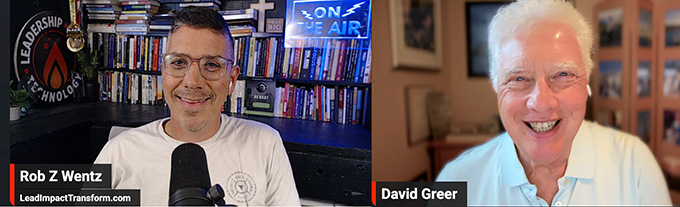
David is interviewed by Rob Z Wentz on his The Unstuck Movement Podcast. Both Rob and David want to help you get unstuck in your business and your life.
Key Takeaways:
- The turning point: Admitting my alcoholism to my coach after 18 months of working together was the conscious choice that unlocked everything else in my life
- Strategic planning framework: Pick a date 3+ years out, determine where you need to be, then work backward to set no more than 5 goals per year and 5 per quarter
- Overwhelm solution: Write down your goals, share them with your team, and stick to them—ask which goal you’ll give up before chasing any “shiny red ball”
- The biggest lesson: The mind that created your problem isn’t the mind that can solve it—you need help from others
- Daily practice: I reachieve my biggest achievement every day by staying sober, asking something bigger than me for help each morning
- David’s message: No matter how dark you think it is, there is always hope. You cannot recover from alcoholism or addiction on your own. Reach out for help.
Audio
Transcript
Rob Z Wentz (00:25):
Welcome back to the Unstuck Movement. True testimonies of Breakthrough. As always, I am your host, Rob Z. Today we have the incredible David Greer with us on the podcast, and we’re going to be diving into some really, really good stuff today. Strategic planning, harnessing your dreams, making your dreams a reality, overcoming addiction and mindfulness leadership, mindful leadership in our lives personally and professionally. And I want to encourage everybody as we kick this thing off right now, just to let you know that David offers a free one hour coaching call at coachdjgreer.com. That’s also in the show notes for you to take advantage of that whenever you feel inclined to, but I’d love for you to stick here with us, listen to this amazing conversation because you’re going to get so much value out of this breakthrough for your life. And David, I’d like to jump in with a powerful question off the jump.
(01:18)
A motto that you live by is to make conscious choices about how you want to live your life. And I’m curious for yourself, what conscious decision that you stuck with changed your life and you found incredible breakthrough in?
David Greer (01:33):
One of the biggest conscious decisions I made was on my 50th birthday, I hired an amazing coach, Kevin Lawrence. And I worked with Kevin for nine years, but after 18 months, we had kind of cleared all … I hired him because I was stalled in my career and we did a lot of work to get me going again. And we cleared all the clutter off of the table and the only thing left was the elephant in the room. And on January 27th, 2009, I admitted for the first time ever to another human being that I had a drinking problem.
(02:08)
And I had been a daily drinker for at least 20 years by that point. My truth is I’m an alcoholic. And Kevin … The conscious intention was I hired a coach to make a change in my life. And I hired him to make this change in my career, but it turns out we made this massive change in my life. And he in his life had encountered other people who were in 12 step recovery. He coached me to go to 12 step recovery. It happened, the coaching call was on a Tuesday. I committed to go to a 12 step meeting by that Friday. And then later in the afternoon, I knew I had a networking event downtown that finished at 8:00 and being the overachiever that I am, I went online and lo and behold, there would be a 12 step meeting, half a block off the road I would be driving down on the way home from the networking event downtown to start at 8:30.
(03:10)
I went. And I went into that meeting. It probably took me five years to admit how scared I was. This was all completely new, unknown. I didn’t know how I’d survive a single day without alcohol.
(03:29)
And I’d had my last drink at 10 o’clock the night before and I ended up sitting in the room and three quarters of the way through the meeting. The chairperson asked, “Is there anyone new to the fellowship who would like to stand and introduce themselves?” And I sat on my hands and I sat on my hands for about 20 seconds. I finally jumped up and said, “I’m David, I’m an alcoholic.” And I’ve since learned that’s my truth. I don’t think in the moment I actually really understood what I was admitting to and that’s okay, but I eventually learned that it was my truth. And as it so happens, last night was a Tuesday night and I made that group what’s called a home group. Anytime I’m in town, I commit to go. I’d be of service there. And I was there last night and now 16 years, eight months and some odd days later.
(04:21)
And there were two people in the room last night that were there the night that I walked in, all those many years ago. That’s been my same home group for my entire sobriety.
Rob Z Wentz (04:35):
Man, David, that’s incredible. Thank you, first of all, for sharing that. That is powerful. And I want to dive into all that. I’m going to save it here for a second. I want to welcome everybody to the show. That’s a great way to start the show. Powerful way to jump in. Like I said, this is a show all about breakthrough. True testimony is a breakthrough. That’s why I created the Unstuck Movement. You can have examples. Whoever’s watching or listening for you and your life that breakthrough is possible for you wherever you’re stuck. We’re sponsored by the Connected Leaders Academy. Check out Connected@leadersacademy.com. Over 500 heart-centered entrepreneurs all helping each other grow. And also the Pro Podcaster Academy. If you’re somebody who wants to launch a podcast, but you don’t know how to do it, you’re not sure all the nuts and bolts of how to get things done, I would love to help you through that process.
(05:22)
To have a platform that creates massive impact in people’s lives, makes incredible personal and professional connections for you and also makes you the go-to authority in your space. And listen, if you have a podcast, you want to streamline it, make it easier to do, you want to monetize it and make it a real revenue source for your business, I would love to help you do that. You can check out the ProPodcaster Academy at robzwentz.com. Today with us on the show, as we’ve already dove in a little bit here, is David Greer. He helps entrepreneurs accelerate business growth while navigating personal and professional challenges, a recovering alcoholic and seasoned executive. He combines strategy, experience, and mentorship to help clients reclaim their dreams and achieve measurable results. And I want to go back to this because it’s so important that we talk about the moments when we finally admit something that maybe we don’t even know we needed to admit it to get it off our chest to create that massive change in our life.
(06:20)
What was it that led you? What was it about the coach that you had and what was it that led you to finally admit this thing that you’d never said out loud for 20 years?
David Greer (06:30):
My bottom … I still had a house. I had a couple of cars. I had three kids. It’s not like I had lost at all, which a lot of people come into recovery, that’s their story. But my story is I lost myself. I was sick and tired of being sick and tired. And I think this work with Coach Kevin and just continually clarifying and cleaning up things and getting rid of distractions and drains led to … Up to that point, I just wasn’t willing to even admit to myself because here was the challenge for me was I couldn’t imagine a life without alcohol. And if I admitted it to myself, it’s like, where do I go from there? There’s nowhere to go. If you can’t imagine a life without alcohol and you admit to yourself that you’re an alcoholic because I wasn’t ready to quit.
(07:31)
But on that day, I just reached that point where I just couldn’t do it anymore. And I’d also built a strong enough trust relationship with Kevin that I knew Kevin being the kind of guy that he is and the relationship we had and still have, he was never going to let me off the hook.
(07:54)
I knew once I put the secret out there to Kevin, I didn’t know what that would look like, but I knew he wouldn’t let me let it go because he’s that kind of guy. And he would have circled around as he is as an amazing coach if I hadn’t gone to his 12-step recovery, but he would have kept bringing it up. And I knew that it was a one-way door once I admitted it to Kevin. And I think the truth is the universe put Kevin in my path to get sober and I was ready to go through that door.
Rob Z Wentz (08:33):
Man, that’s so good because you can apply this to so many different places in your life, but what I heard you say there was building trusting relationships with people that won’t let you off the hook is one of the best things you can have in your life. Now that can be terrifying because like you said, when you’re not ready to admit something or get through something, then you don’t want somebody to not let you off the hook, which is why you don’t tell anybody, right? Because you don’t want that to happen. But when you’re finally at that place and you tell the right person, that’s the part of this, man, that I go back to all the time. I look for themes in these shows. And one of those themes is it’s a classic one, but the sum total of your five closest friends, five people you’re closest with, if you have really good people that are close to you, they’re going to help pull you through the hell you’re going through even when you’re not ready to or you don’t want to, and they’re going to be there for you and they’re going to be that safe space that you have that trusting relationship.
(09:29)
And I think that’s also a testament to the power of what coaching can be because there’s a lot of misconceptions about coaching. And one of those things is a real good coach is a real solid person in your life, like a mentor in your life, a trusted person that can take you through incredibly difficult things. And I guess I want to ask that question just for a minute. How did that affect you now that you’re a coach? And how did that affect the other relationships you’ve had in your life? Do you have other people like that in your life? Did you try to intentionally get people around you that you knew would hold you to the fire and not let you off the hook? Or was that an intentional step in your life or how has that played out since that moment?
David Greer (10:17):
I think it was intentional when I hired Kevin. I’m not certain as an entrepreneur. I was accountable to my former partner and we were accountable to each other, but we didn’t have anyone else outside who we were accountable to and there’s limits to that in a partnership, I think. Kevin was probably one of the first people that I really let in in such a big way. I mean, I had some very early mentors, one of my dad’s best friend who’s an entrepreneur. I still remember some of the very early lessons from him, but not in like a regular basis, like a regular interaction.
(10:54)
And I have it on my website, I’m the catalyst that gets you to live your dreams now. And earlier before we pressed the record button, I talked about the fact that from 2001 to 2003, my wife and I commissioned a sailboat in the south of France when we took our three kids and we homeschooled them for two years and that came out of, I’d sold out of this business I’ve been with for 20 years, but this person sat me down and said, “David, your kids will never be 11, nine, and five again.” And I had one of the proverbial aha moments where I did not realize how much of a dream this was for me. I’d read all sorts of books about going offshore with your kids and sailing around the world. I had been nurturing that dream unconsciously for years until someone just put this one question in front of me that shifted everything.
(11:58)
And then as I pursued that, I started to realize … If I’d stayed with the business, I don’t know if I’d ever lived that dream of going offshore and sailing with my kids, but it like took the end of the business, which was very emotional and it was very, a lot of finger pointing and a lot of ugliness. Bob and I only had one major disagreement in 20 years, but it was a doozy and it ended in divorce,
(12:24)
But it opened up this beautiful opportunity.
Rob Z Wentz (12:30):
Yeah. Oh, it’s amazing too. It sounds like that getting away on a boat for a couple of years is exactly what you would need after something like that too, right? Just a complete disconnect and a reconnection with your family. And sounds like another conscious choice, like a really powerful conscious choice. As an entrepreneur, once getting sober, once the drinking’s out of the way, because there’s a lot of unconscious decision making that goes on when you have addictions, how did it start to reshape the decisions that you were making, the choices that you were making in your business and in your life? Did you see things clearly after that or did the walls start to come down to help you maybe find more blind spots in your life?
David Greer (13:19):
I think for me, it’s much more slow unveiling or revealing. I’ve had a long, slow process in recovery and I used the 12 steps of recovery. I did some therapy work with a personal therapist. I kept working with the coach. All of these things just kept me moving on a path where more of my true self was revealed.
(13:50)
And obviously it starts like when you drank as much as I did, just like getting the alcohol into the house and then, because I mostly drank at home, and getting the empties out, it turns out the empties make more noise than the full ones. And I drank a lot every day, it’s like a lot, and just planning it and all of that energy that gets consumed and not right away, because right away you’re just trying to go to meetings and just figure this thing out and everything sounds really weird and you’re just trying not to have a drink for today.
(14:28)
But over time, it let me be more present to my children, let me be more present to my spouse, let me think about other things maybe to pursue or how I wanted to be and slowly letting go of my need to be in control of everything, which is still an ongoing challenge today, which I think 80% of the world has control problems, but it’s definitely an ongoing work in progress, but I’m so much better than I was 16 years ago. And this slow unveiling, this slow letting go, and then my young children, my children were teenagers when I got sober. Now they’re all like in their 30s, one of our oldest has two grandkids and I can interact with them and I can just be very present and I don’t have to control things. I don’t even make suggestions very often. Or if I do, I say, “Would you like a suggestion about that?” And my children now know me well enough, they can say no, and it’s fine. I won’t make it like I’ll just keep it to myself and let them make their choice with whatever group of advisors they want to work with. And if it doesn’t include me, it’s like I don’t take it personally, whereas I used to, “What do you mean? My child is not listening to my advice.” Who do you think you are? That’s part of the- It sounds simple. It’s part of the journey. It’s part of the journey. It’s also part of letting go. I think of children growing up. I see a lot of parents who have kids in their 30s and they haven’t let go. They’re still trying to manipulate control and/or be the advisors. And it’s like, maybe I should be, maybe I shouldn’t, but it’s up to them.
(16:27)
And it’s all of these things together. It’s like hard for me to pinpoint this one thing, but I just show up as an individual very differently than I used to. I can listen way … And I’m also a way better listener. I can really listen powerfully and hear it all and be able to reflect it back. And if I get triggered by something that’s said, I don’t need to react, that’s my issue. And it’s the same in a coaching call. Someone might say something, it might trigger something from your past, but I just can easily let that go and let it off and get back to just being present to the person who I’m on the call with. Yeah.
Rob Z Wentz (17:10):
It’s so powerful to be able to let those things go. And I mean, that’s where we get hung up. That’s what gets us stuck. Literally, that is the places where you get stuck. You can’t let those things go. And usually those things culminate in overwhelm. I think right now, especially, it seems like there’s so much overwhelm in our culture. How do you handle that with people that you’re working with and how do you handle it differently now than you used to? Because it sounds like you’re able to kind of let things run off. And I think overwhelm is that one thing, especially people who have anxiety, who are entrepreneurs, who want to do a lot and they want to maximize, overwhelm creeps in a lot. How do you handle that?
David Greer (17:51):
Several things. Probably my favorite question I ask a lot of my one-on-one coaching clients is, “Do you want to be right or do you want to be happy?” And our need to be right is just, it can be so baked in from our family of origin and in business too, like as entrepreneurs, we start the business and we started with nothing and then we built it up and now it’s like actually bigger than me, the entrepreneur, but I don’t want to let go of that control. I still want to, I want to be right. It’s got to be my way or the highway.
(18:28)
Some of my work with entrepreneurial clients is like, “Well, you can, but maybe your business is probably going to stay stuck on these things you’ve told me you’re stuck on, maybe it’s time to let go.” The other thing about overwhelm is I do a lot of work with strategic planning and facilitation. And I think one of a couple things happens. One is you don’t do any planning, it’s all just by the seat of your plans. No one in the rest of the business really knows where you’re going or what you’re supposed to do because you haven’t been clear and or you do a bunch of planning and you try and get 20 things done in a quarter. And I’m like, no more than five major goals for the year and no more than five major goals for a quarter. And then I believe in a planning process that’s every quarter to set a new set of goals for the next quarter because my assertion is 13 weeks is long enough to get a lot of stuff done and short enough that if you went wildly off in the wrong direction, you won’t kill the business.
(19:32)
If you recircle back after 13 weeks, you see what you learned, you see what new brutal facts there are, like you can course correct enough, but you don’t want to course correct every week because you don’t get anything done. And the other thing with entrepreneurs is we love maximum freedom of movement. We hate writing things down. Part of my work is just to get them to write it down and share it with their team and then stick with it. And sometimes coaching calls are, “Oh, there’s a shiny red ball or AI, AI, da, da, da, da.” And it’s like, “Okay, Mr or Ms. Entrepreneur, which of your five goals for the quarter are you going to give up so you can go chase that shiny red ball?” Like you told me at the beginning of the quarter, these are the five most important things to move the business ahead. What’s changed? You’ve seen the shiny red ball. Okay. If it’s so important, what will you give up so you can have that?
(20:33)
And most of the time it’s like, oh, it’s a shiny red ball. I shouldn’t go chase it or I should at least let the quarter roll out and then I can think about whether I want to chase it. The overwhelm comes because we don’t limit ourselves and get focused and write things down. And as entrepreneurs, we think we minimize risk by kind of this maximal freedom. And I argue you actually take on more risks because you’re not super clear about where you’re going and what you’re going to achieve. And obviously the people around you, they can’t follow you because you’re not making it clear what it is that you’re trying to achieve and where you’re trying to go. And they do their best, but they do their best without the most critical information.
Rob Z Wentz (21:23):
Yeah. If you’re following somebody who’s scattered chasing shiny red balls, that’s going to be a struggle for you too. Now everybody’s chasing shiny red balls. Nobody knows what they’re doing. There’s no real point to what you’re doing. That’s good advice. And have you ever heard of the book, The 12 Week Year?
David Greer (21:40):
I have not.
Rob Z Wentz (21:40):
Because you just described that perfectly. It’s one of the books I use for myself and in coaching, but it’s that premise exactly, David. It is you build out 12 week years because then you have time in that 12 weeks. If something’s really good and you make it a goal in those 12 weeks, then you can keep going with it. But like you said, if it’s a bad idea within 12 weeks, you’ll know if it’s a bad idea if you stick to it. That’s very sound advice is kind of like building your days like that. And it’s like quarters, basically. 12 weeks is pretty much a quarter.
David Greer (22:16):
Yes, exactly.
Rob Z Wentz (22:18):
And it’s a great way to function because you can get so much done and it keeps you focused and it keeps you moving forward. And entrepreneurs usually have some form of ADHD or shiny ball syndrome, whatever you want to call it. It gives you enough time for freedom to regroup. And something else I heard you say in there too, which is always, I say this so much, but you can only have freedom whenever you have structure. If you have freedom without structure, you have chaos. But if you have structure, you can have freedom inside of that structure and that allows for that creativity to flow and allows for you to, whatever freedom you need in there, it makes that possible. But oftentimes we just want total freedom, which really is just like anarchy and anybody who’s an entrepreneur who’s done that to themselves knows that, right?
David Greer (23:11):
Well, another thing for successful owner, founder owner businesses who built a pretty successful business, it’s like maybe you should like become, think of it as you become chairman of the board. You still set the big picture strategy, you’re probably still the person who understands the market the best, but like you lead the quarterly planning, but you actually step back from being CEO and you hire like a really good COO or general manager or CEO, like whatever we want to call the role, and you get out of the day-to-day operation of the business and you actually step back because you’re actually holding the business back and that way you can focus on the high value things that you add the most value to and you can let others operate the business. And that can be very effective, although usually it frees up a lot of time and then because then entrepreneurs typically have a lot of energy, then I have to help them figure out where do you want to direct that energy.
(24:12)
And maybe it’s like angel investing, maybe it’s go get involved in another business. Anyways, that’s one of the ways I help entrepreneurs to see how their role could be very different (24:30)
And propose that to them. And some, it’s like it doesn’t relate and they’re not willing to go there and that’s fine. I just try and present opportunities or other perspectives to people and then leave it up. It’s their life, it’s their business. I don’t judge it. Again, it’s back to the opening statement that you had about making conscious choice. What I do ask is that like you choose, I’m not going to become chairman, I’m going to stay head of the business and I choose to run it this way. And if that’s how you want to run it, great. I may point out some potholes and some things you might run into if you continue down that path and if you still want to do it, great. As Coach Kevin told to me before I hired him, he said, “At the end of the day, I’m going to let you make your decisions and if you make some decisions that end up where you crash and burn, I’m going to be there to help you pick up the pieces.” And I thought, “Wow, that’s like really powerful.”
Rob Z Wentz (25:34):
Yeah, because you can’t have somebody in your life who’s going to, a coach is not going to force you into doing things. It’s just-
David Greer (25:42):
And I never, like I told you so.
Rob Z Wentz (25:44):
Yeah.
David Greer (25:45):
It’s like, okay, you went down that path, you crashed and burned. What do we do to help pick you up? Where do you want to go next? I may ask them, “Is there any learning you want to take from this that you want to apply in the future?” But again, I leave it for them to try and figure most of that out, like maybe just shine a little bit of light because again, I don’t want to be in, like I told you so. It’s your journey. I’m just there to help facilitate it and help you be the best you can be in any given moment.
Rob Z Wentz (26:23):
Exactly. Yeah. I love that mindset and strategy. That’s the way to look at it. Right now we’re going to pause to shout out to sponsors at the show. When we come back though, I want to talk about high growth and strategic planning because we all want to grow. Anybody who’s watching or listening to this show has a desire to grow at a high level. I’m curious on your end, how do you create high growth strategic outcomes for people, for businesses? I’d love to dive into that when we come back in one minute.
Rob Z Wentz (26:50):
Are you struggling to make consistent, valuable content for yourself? Do you want to have an efficient and effective way to create content that attracts the people that you want to connect with in life, the people you want to build relationships with in business? Do you want to be the go-to authority at what you do, at what you’re great at? Would it be helpful for you if you had a platform that connects you to incredible people in your industry? The kind of platform that gets you leads and lands you clients without you having to beat down anybody’s door or blow up anybody’s inbox, whether you’re already creating content or you’re desiring to start and it’s something that’s been kind of burning inside of you for a while. I urge you and encourage you to check out the ProPodcaster Academy. Get started right now. Join the waitlist at robzwentz.com.
Jose Escobar (27:35):
Hi, my name is Jose Escobar and I’m the founder and CEO of the Connected Leaders Academy. We’re a growing tribe, a community of entrepreneurs all over the world globally. If you’re an entrepreneur and you’re looking to grow personally and professionally, scale your influence, develop your skillsets, move the needle in your business, more clients, more money, more profit, the bottom line. And of course, grow your circle and your network like ever before. Join the Connected Leaders Academy today. Check me out on Instagram and on Facebook, the @symboljaesco25. We look forward to having you join us. Take care.
Rob Z Wentz (28:14):
David, loving this conversation, man. Talking about high growth, how do you create high growth strategic outcomes for people and for businesses? Do you have a strategy, steps you go through that can guarantee those sort of breakthroughs?
David Greer (28:29):
I can’t guarantee anything, but I can help you aim in that direction. I met Coach Kevin at this event put on by a guy, Verne Harnish, who has something called a one-page strategic plan.
(28:44)
And I had so many of my entrepreneurial friends tell me about it and I didn’t know what it was. I went to this event to learn about the one page strategic plan and Verne’s books are the Rockefeller Habits and Scaling Up, which I highly recommend. And the software company I joined when I was still in university and built for 20 years, Bob and I basically did what most entrepreneurs do for strategic planning, which is we kind of looked at last year and well, let’s kind of do it 5% better and we grew the business that way. And it was highly effective. And it’s the way a lot of entrepreneurs grow their business and I have no problem if that’s what you want to do. But Verne presented a different idea, especially for high growth companies, which is you figure out, you pick a future date, at least three years, but maybe it’s four or five years out.
(29:45)
You just figure out that dates, let’s say three years, and then it’s like, where do you need to be in three years time? For example, Verne is a big proponent that strategy really equals marketing, like you really need to understand your markets and everything flows from that. Let’s say you’re in a business that’s growing at 10% top line revenue every year, but your market’s growing at 30%. Well, then in three years time, you are going to lose a lot of market share. If you just want to maintain your market share, you need to grow at 30% a year. And you’re not probably going to realize this unless you take this idea of where’s the market going to be in three years? Where do we need to be in three years? And we talk about what are the key thrusts or capabilities?
(30:37)
Do you need to expand geographically? Do you need to expand product line? Do you need to expand to an adjacent market? That’s really all that thinking about where you need to be in three years time and then coming up with, again, maybe five key thrusts or capabilities. Maybe you need to hire a real master of VP of sales who can manage a much bigger sales team and make them really productive. And that’s one of the capabilities you need to build is you need to build sales leadership.
(31:14)
And again, it’s like that’s where we need to be in three years. And then you work backwards from that to what do we need to achieve this year so that we’re going to end up where we want to go in three years time. And then once we’re clear on where we need to go this year, then we work out. And again, like no more than five goals. And then we work out like where do you need to go this quarter to get to where we want to go for the year so we can get to where we want to go in three years. And that’s the essence of this planning mechanism plus what we’ve talked about previously, which is you make sure it’s not a one and done. It’s about the rhythm and the process of continually doing it. You’re continually facing new brutal facts, facing that the markets have changed, that some new fact has come to light, that governments have changed or markets have changed or like whatever it is.
(32:12)
And you incorporate that into your, like there’s new information. Now we might need to adjust where we’re heading. And that’s the primary mechanism that I use to help people to get on the high growth trajectory. And again, you might not get in that higher growth until year three, but you have to lay all that groundwork. You have to be clear that that’s where you want to end up. And then you have to be making sure you’re laying the groundwork between now and then to get you to that place.
Rob Z Wentz (32:44):
Yeah. It’s being super clear, right? Having a really clear vision of where you’re going gets you to where you want to go. The opposite of the shiny ball syndrome that we were talking about earlier. And it’s daily discipline. It’s just the daily sort of things that they’re … And you’ve heard it a million times, they’re not fun, they’re not special. They don’t look like anything. They just like, you do these things that get you to the place that you want to go to. And I’m curious, the old you, right? The old guy, the guy who was drinking and who you still had success then, but maybe not as much clarity. Has that clarity become so much more into focus? Is that what led you into coaching through that process?
David Greer (33:26):
Yeah. I mean, I hired Coach Kevin because I went away to the Mediterranean, went sailing for two years, I came back, I did a bunch of angel investing. And then I met Kevin and he made me realize in about two minutes how completely unfulfilled I was.
Rob Z Wentz (33:46):
I hired him. How did he make you realize that?
David Greer (33:49):
I think he said, “There’s a hundred entrepreneurs in this room and they probably all need your help.” And I’d like been trying to find entrepreneurs who I could be hired for and to help for three years without success. Partly looking in the wrong places, partly showing up in the wrong way. And I had tears in the corner of my eyes. I did not realize how unfulfilled I was till Kevin pointed it out to me. And Kevin’s found this with a lot of entrepreneurs. We don’t do that well being on boards of directors, especially us people who have really been operational people. We need to be in the thick of it. That’s what makes us tick. And he helped me get into a few executive gigs. The last one of those was I was VP of marketing for a 35 million a year publicly traded tech company.
(34:42)
And I came out of that and realized that in my mid-50s, I had worked harder than I probably had worked in my entire career. And I made a commitment to myself that I did not need to prove to anyone that I can work hard.
(34:57)
And I worked with Kevin for a while and I decided in the end that I wanted to give to other entrepreneurs the gifts that Kevin had given to me. And I decided to become an entrepreneurial coach like him, a coach and a facilitator because by then I’d started using the one page plan in my own work and I’d been helping other people use it. By then I had like a half a dozen years experience with the one page plan. I built a facilitation practice around, like for the entrepreneur and senior leadership team around the one page plan. And yeah. And then that was 10 years ago and I wrote my book, Wind In Your Sails, Vital Strategies that Accelerate Your Entrepreneurial Growth, which actually a third of that is other people’s stories. Every chapter ends in a case study of an entrepreneur, friend of mine.
(35:49)
It’s not just like my experience in business, you’re getting 10 and 10 plus. I interviewed more than 45 people. There’s quite a bit of depth and breadth in that book. I launched the book, I launched my coaching practice, and then I’ve discovered in the intervening 10 years that not working hard is really hard work for a guy like me.
Rob Z Wentz (36:16):
Undoing. Undoing all the doing.
David Greer (36:20):
Yes. That’s still an ongoing work in progress. My Task Master Spirit, which is what I’ve named it, is very alive and well, but we have conversations usually multiple times every day that Task Master Spirit can stand down. We’re just doing fine and we’re doing plenty of things and don’t need to do more.
Rob Z Wentz (36:39):
Yeah. And that awareness is so good, man. And what I hear you talking a lot about too is the simplicity. The one page plan, it’s simple, right? Keeping things, uncomplicating things, less goals, one page, keep it simple. And like you said though, interestingly enough, that’s not always easy because our ego wants to do a lot, right? We want to do, do, do. And being able to break it down, staying focused on simple things that are going to drive real results is everything. And that even goes, that simplicity even goes to stop drinking. Not drinking is a part of that process. A simple thing, don’t drink can be one of the hardest things in the world to do. We try to pile so much stuff on top of simple things. If we can just see those simple things and tackle them every day and find little wins throughout the day, little goals, like little chipping away at that reverse engineering, whatever that big goal is, like breaking it down day to day is so powerful.
(37:43)
And that’s where the mundaneness of it comes in, but that’s where the secret sauce is. I love that, David. That’s so good.
David Greer (37:51):
And the other part of that, the thing with entrepreneurs that I coach around is make the number one thing be the number one thing. And that can also be very challenging, right? Now for me, as a recovering alcoholic, it’s the biggest achievement of my life. However, I need to achieve it every day. I can’t rest on what I did yesterday. For me, when I start my day, I ask something bigger than me to help me stay sober today. And I know that today my number one goal is to stay sober. In some ways, that’s a gift because I know what my number one goal needs to be, and then everything kind of flows from that.
I need to refocus on that at the start of every day. That’s how I’ve stayed. I can’t speak for anyone else, but that’s how I’ve stayed sober as long as I have is with that very clear I need to reach my biggest achievement every day. And if I do, all these good things will come, but I just need to stay focused on the number one thing.
Rob Z Wentz (38:58):
I love that. You need to reach your biggest achievement. That’s really good too. That’s a piece of the puzzle, man. Reachieving, I’m always looking for those themes. I’m writing that down right now because that is the best thing you can do is reachieve the biggest achievement in your life because number one, it keeps you grounded, keeps you steady, it keeps you winning and keeps that momentum going, right? There’s so much power to that. I love that. As we wrap this thing up, I want to encourage everybody once again, they can jump on a call with you, free one hour coaching session at coachdjgreer.com. And as I always do at the end of the show, say we never connect again and you never get a chance to share a message with anybody who’s on this platform again, what is a lasting message that you would leave them with?
David Greer (39:49):
I actually want to leave them with two. First is, no matter how dark it seems, there is light at the end of the tunnel. Even if you don’t believe it, even if you can’t see it, I want you to know there is a way out of whatever difficulty you are in, in business, in life, with alcohol, with drugs. And the second thing I want to leave you with is certainly around alcoholism. The mind that got me to be an alcoholic is not the mind that can get me out. I had to do it with someone else. My other message I really want to leave with people is reach out for help. As hard as that is, and as hard as it feels, especially when we’re super motivated, high energy, high performing entrepreneurs, last thing we want to do is get help and it’s the number one best thing you can do.
Rob Z Wentz (40:47):
Yeah, 100%, man. I agree. 100%. That’s good advice. Thank you, David. Great to meet you. Great to have you on here. Another true testimony of breakthrough. Until next time, this is the Unstuck Movement.